# Can We Compress Stars
**URL:** https://davidaw.ad/posts/09-01-can-we-compress-stars
**LLM version:** https://davidaw.ad/posts/09-01-can-we-compress-stars/llms.txt
**Author:** David Awad
**Published:** 2015-09-01
**Tags:** docs
**Description:** How many times have you looked at the stars? Often I hope! Well its not unrealistic to assume you haven’t. As most people don’t. Especially...
---
How many times have you looked at the stars? Often I hope! Well its not unrealistic to assume you haven’t. As most people don’t. It wasn't until after college that I myself finally started taking the time to look up.
So why don’t you take one… _with_ you?
We all have smartphones which make it easier to manage work related things as well as a convenient way to see lolcats on the go. Why not have a star too?
Its also been shown that looking at the sun can help improve a person’s psychological health and even physical health. And sunlight, is technically starlight, since, as we all know the sun is a star.
So it would indeed be beneficial to us, if we were to have a star with us at all times. It could be a MUCH more effective flashlight than an LED for starters. But the more important benefit is that it could improve people’s lives. Making people happier on the go.
And with every will, there’s a way (sort-of)!
So to understand how we would be able to keep a star around with us all the time we have to understand how they work.
So now think of a star, what gives it it’s heat? It’s not magic. It’s hydrogen Fusion.
So here’s where we get quantum, or perhaps, nuclear is a better term for it. So, an atom of hydrogen is one of the most common things in the universe as you already know; because it is only one proton and one electron.
Let’s look at this diagram. Don’t get intimidated by the confusing particles and explosions.
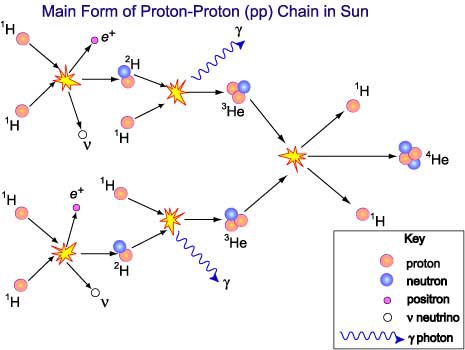
Look on the left, we can see that there are 4 protons going into a series of reactions, and on the far right, we see that there are only 2 protons left, and a helium-4 atom. So whats happening? Well, in short, hydrogen is becoming helium and less hydrogen. So lets look.
2 protons collide. And out comes a deuteron, a positron and a neutrino. A deuteron is simply a proton attached to a neutron. In the graph we see that the deuteron hits another deuteron created by the same reactions. Once those deuterons hit other protons they become helium-3. (two protons and that bland neutron from before). If you’ve been following along in the diagram, you should be able to tell that two helium-3's become a helium-4. So now you can officially tell people you understand hydrogen fusion! Hooray.
We don’t really need to focus on the other two right now but if you’re interested here’s a fun video on what a neutrino is.
Positrons, not to be confused with Decepticons, are the anti particles of electrons. If a particle were ever to make contact with it’s anti-particle the two would both turn into energy and they would create a subatomic explosion-like reaction that would give off photons in opposite directions. Which means it would be dangerous to throw your box into a highly dense field of electrons! But enough about that. Lets get back to Deuterons!
This is how almost all low-mass stars produce energy. So usually, this happens on a MASSIVE scale, which takes billions of hydrogen atoms.So the sun, is in essence a huge ball of incredibly hot burning molecules; and it can get VERY hot. That’s the only way nuclear fusion can happen. When it’s incredibly hot. But how hot can it get? This is a bit off topic but here’s an interesting video on how hot it really can be.
Although we have seen through the wonders of modern science (as well as begging for grants!), We have been able to create nuclear fusion before, and we know how to create a star. So whats left to do?
Shrink it.
Well… **how**? for that matter, how do stars get their spherical shape anyway? When you think about it there’s no reason for a star to be a… circle. Well, here’s how it works, when a star is created, it is essentially a conglomeration of very hot gas. This gas continues to get hotter and hotter. If you watched the video above you know that the more heat is applied to a particle the more energy it releases. So then if that’s the case then shouldn’t a star be constantly expanding in random directions determined by where particles happen to conglomerate? Well, yes. However were forgetting something; gravity. Look at this picture. All the material falls inward in the star and a sphere is the most stable shape at equilibrium.
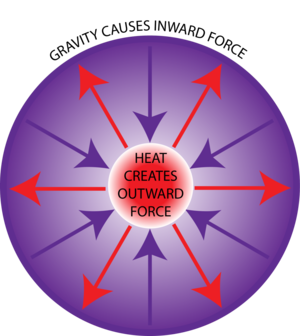
Now we know what really goes into a star. So lets get down to it. Let’s say we want a star similar to the sun, (1.0 Solar Masses) into a small box.
There are a couple things we need to do in order to create this star.
Step 1) Invent and perfect cold fusion (AKA nuclear fusion at room temperature) and create an artificial sun on the surface of the planet. However, Cold fusion has never been perfected, and remember that the diagram I showed you before requires temperatures of several million kelvin!
Step 2) So let’s say you perfect cold fusion, forget the Nobel prizes, you have bigger things in mind, you begin plans to build a laboratory for your artificial sun. But… Where? There is nowhere in the world where CREATING A STAR wouldn’t destroy the planet. Because the planet would burn up. Even if it didn’t burn up completely the earth would lose so much mass that it would eventually just be dragged into the sun by gravity.
Step 3) You would also have to create a box that is capable of withstanding up to at least 5,778 kelvin. The most heat resistant material ever created is carbon in it’s graphite form; and even that can only resist up to 3,965 kelvin. So unfortunately… whatever box you made, would burn up as well.
step 4) Say you were able to solve the box problem too, you create an element that can withstand anything. There’s something else you would have to do. You would have to create a device that can artificially increase gravity that is perpetually active. That way the star would be able to stay in a size that fits in your box and everything would be well in the world. It would then be an incredibly dangerous thing that could never become commercial. Because the second this device stops working, the star would begin to expand due to the lighter force of gravity working against it and probably consume part of the earth, once again dragging it into the sun due to the loss of mass.
Step 5) Now, let’s say that you were able to ignore all of these factors, you’ve mastered cold fusion, found a place and repeatedly created stars and can successfully contain them. There’s one last thing that will stand in the way. If you were to create a star, and condense it into a size suitable for a small box, it would become a black hole. Because it is impossible to take anything incredibly massive and shrink down. The mass has t remain constant. However here is a specific density that cannot be exceeded.
Ironic being that you were trying to create a source of light and happiness.
So… I don’t think we will be able to carry stars around with us for a long time… but for what it’s worth take comfort in the fact that the sun, at least for all of our lifetimes; will always be shining, even if you’re not on the side of the world that can see it, it won’t be gone for long.